
Tech giant Apple reported a record June quarter revenue of USD 109.4 billion, a 16 per cent year-on-year increase, with significant double-digit growth in emerging markets like India. However, the company anticipates business risks in the coming quarters due to rising memory chip prices and ongoing supply constraints.

'It was diminishing even before Trump came to power.' 'The US was at the centre of the global economy. That position is going to become less and less important and less central.'

'Markets never fully lose hope. But an important shift could come if the Strait remains closed -- moving from high prices to no prices.'

The question is whether the clocks allow enough time for two deeply mistrustful sides to get there, and whether the surface calm holds long enough for the paddling to produce something before the ceasefire ends on April 22, notes Prem Panicker in his must read blog on the Iran War.

The LPG squeeze on India's restaurant sector is the quotidian face of a deeper crisis.

The cost of the war is being counted not in the corridors of power in Washington or Tehran, but in Firozabad's darkened furnace rooms, Howrah's idle casting sheds, and a barbershop in Kochi where the wait is suddenly, inexplicably, an hour long, notes Prem Panicker in his must read blog on the Iran War.

...is a way out, notes Prem Panicker in his must read blog on the Iran War. What the indefinite extension produces is a prolonged condition of not-war-not-peace, in which oil markets cannot stabilise, Asian refineries cannot plan, European governments cannot stop subsidising consumption they cannot afford, and the next flashpoint -- a seized tanker, a miscalculated drone strike, a Truth Social post that claims too much -- is one news cycle away.

Karex, the Malaysian company that makes roughly one in five of the world's condoms -- about five billion a year, supplying Durex and Trojan among others -- announced this week that it is raising prices by up to 30 percent. The reason is the Strait of Hormuz.

Trump may strike. He may announce productive talks and extend again. He may do both at the same time. Iran will not open the Strait on someone else's terms, so no matter what happens, that problem will remain unsolved. And the IRGC will still be collecting its $2 million toll from every ship bold enough to ask permission to pass.

'Was the five-day pause ever meant to hold, or was it simply another instrument of signaling, of positioning, of buying time in a war where even the pauses are tactical?' asks Prem Panicker in his must read daily blog on the Gulf War.

By all available indications, the White House drafted a face-saving note and handed it, ready-made, to Islamabad. Pakistani Prime Minister Shehbaz Sharif was supposed to then post it in the guise of a plea urging Trump to extend the deadline by two weeks 'to allow diplomacy to run its course'. Trump would then graciously accept Pakistan's 'request' and declare a ceasefire. Sharif dutifully posted the message on X. Except that he, or whoever was handling the account, forgot to delete the tell-tale first line visible in the edit history: 'Draft - Pakistan's PM Message on X'. Prem Panicker's must read blog on the Iran War.

This weekend, Donald Trump has begun to say the quiet part out loud -- that he wants to take control of Iran's oil, a formulation more in line with his robber-baron style of international relations.

Iran is fighting a different war: Older, slower, and in some ways more dangerous. Iran doesn't need to shoot down an F/A-18. It only needs to make the Strait of Hormuz feel dangerous long enough for insurance markets, shipping companies, and oil futures traders to do the rest. Prem Panicker continues his must-read daily blog on the war in the Middle East.

Sonia Gandhi has criticised the Modi government's silence on the assassination of Iran's Supreme Leader, arguing it raises doubts about India's foreign policy direction and credibility.

What we are watching is something different: A fog manufactured and maintained by the people who started the war, so that the question of why it was started never has to be answered, observes Prem Panicker in his must read blog on the war in the Middle East.

The United States, which entered this war in expectation of a short, sharp win along the Venezuela model, is now preparing for deeper involvement in a conflict it does not fully control, without the allies it typically relies on, against an adversary that is not behaving as expected, in a global environment that is already absorbing economic shock. Prem Panicker continues his must read daily blog on the Gulf War.

Israel and the United States had a plan. Iran punched back. And now the Gulf is reeling, the world is beginning to feel the pain and, as on date, no one in Washington or Tel Aviv appears willing to admit that the punch has landed, notes Prem Panicker, continuing his must-read blog on the war in the Middle East.
Beijing's latest weapon, 15 times more powerful than TNT, signals a new frontier in high-impact, non-nuclear military technology.

He chose what was best for India, not for himself. Few can deny that when god took Shastri away so soon, they did India an injustice, points out Harishchandra.
The crisis may not be as visible this time, but the stakes are just as high, points out Rajeswari Sengupta.

Businesses are testing new markets, tapping into domestic demand, and pushing the government for relief.

GST 2.0 may cushion consumers against US tariffs, but like the 2019 corporate tax cut, it risks being another tactical fix rather than a structural growth strategy, expects Debashis Basu.
'If India attacks Pakistan, Bangladesh should occupy seven states of North-East India.'
In trade negotiations, as in chess, sometimes you need to accept a temporary disadvantage to secure a better long-term position, points out Sonal Varma, chief economist (India and Asia ex-Japan) at Nomura.

South Indian filmmakers have kept their focus on the single-screen cinemagoer. They have kept their finger on the pulse of the single-screen cinema fan, who goes to movies once a month or more, to forget his weekly chores, explains Ambi Parameswaran.

'As the global economy undergoes significant transformations in 2025, India's ability to navigate the complexities of trade wars, financial realignments, and emerging blocs will be pivotal,' explain Harsh V Pant and Soumya Bhowmik.

Terming as a "watershed" event the killing of Osama bin Laden by the United States in Pakistan, Defence minister A K Antony on Friday said it will have a "ripple effect" in the India's "strategic neighbourhood" and asked the Armed Forces to be prepared for any eventuality.
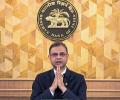
'A repo cut will be very good for the market as it will mean that everything is being done to spur growth in these uncertain times.'
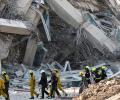
The earthquake rocked many parts of Thailand including its capital Bangkok, the venue for next week's summit of BIMSTEC regional grouping that is scheduled to be attended by Modi among other leaders.
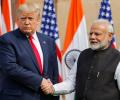
The China threat continues to resonate in the strategic partnership between India and the USA, points out Rup Narayan Das.
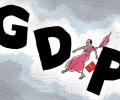
The upcoming Union Budget to be presented on February 1 is likely to assume a nominal gross domestic product (GDP) growth between 10 and 10.5 per cent for FY26, a Business Standard poll of 10 economists showed. The first advance estimates released by the National Statistics Office (NSO) had estimated a nominal GDP growth of 9.7 per cent for FY25. Nominal GDP, calculated at current market prices, factors in the effect of inflation. It is used as the base to calculate crucial macroeconomic indicators, such as fiscal deficit, revenue deficit, and debt-to-GDP ratio.

'The reform agenda is progressing in the right direction'.
A year after a Hamas attack against Israel on October 7 and the ensuing Israeli invasion of the Gaza Strip, India's trade with most West Asian countries has largely escaped any major disruption, except with countries like Israel, Lebanon, and Jordan. However, repeated flare-ups of geopolitical tensions in the region continue to drive up shipping and logistics costs.

China's debt is dangerously high at close to three times its GDP, with the ratio having nearly doubled in recent years, observes T N Ninan.

The highlight of the occasion, according to officials, is an address to a special gathering in the morning by President Xi Jinping, who cast himself in the mould of Mao Zedong, the founder of the Communist Party of China as it is officially called.

The Indian position on the Russia-Ukraine war and the unconditional treaty between China and Russia appear to have caused some ripples in India-US relations and led to a reappraisal of India's usefulness to the US in the eventuality of a conflict with China, notes Ambassador T P Sreenivasan.

The only way to resolve the current military standoff along the Line of Actual Control in eastern Ladakh was for Beijing to realise that trying to 'change the status quo by resorting to force or coercion, is not the right way forward', India's ambassador to China Vikram Misri said in a hard-hitting interview to PTI.
The ripples of the Chinese property slowdown could be felt far and wide across the world.

The agency said, 'The downgrade reflects Moody's expectation that China's financial strength will erode somewhat over the coming years, with economy-wide debt continuing to rise as potential growth slows.'

'People had a perception that I may be angry as a person.' 'Or I'm older than I really am.' 'Or I can't speak in English because of the characters I've done at the beginning of my career.'
